
Air Conditioning Running Costs and Solar
Air conditioning works hardest after sunset, which is the problem with the solar pitch.
The awkward timing problem
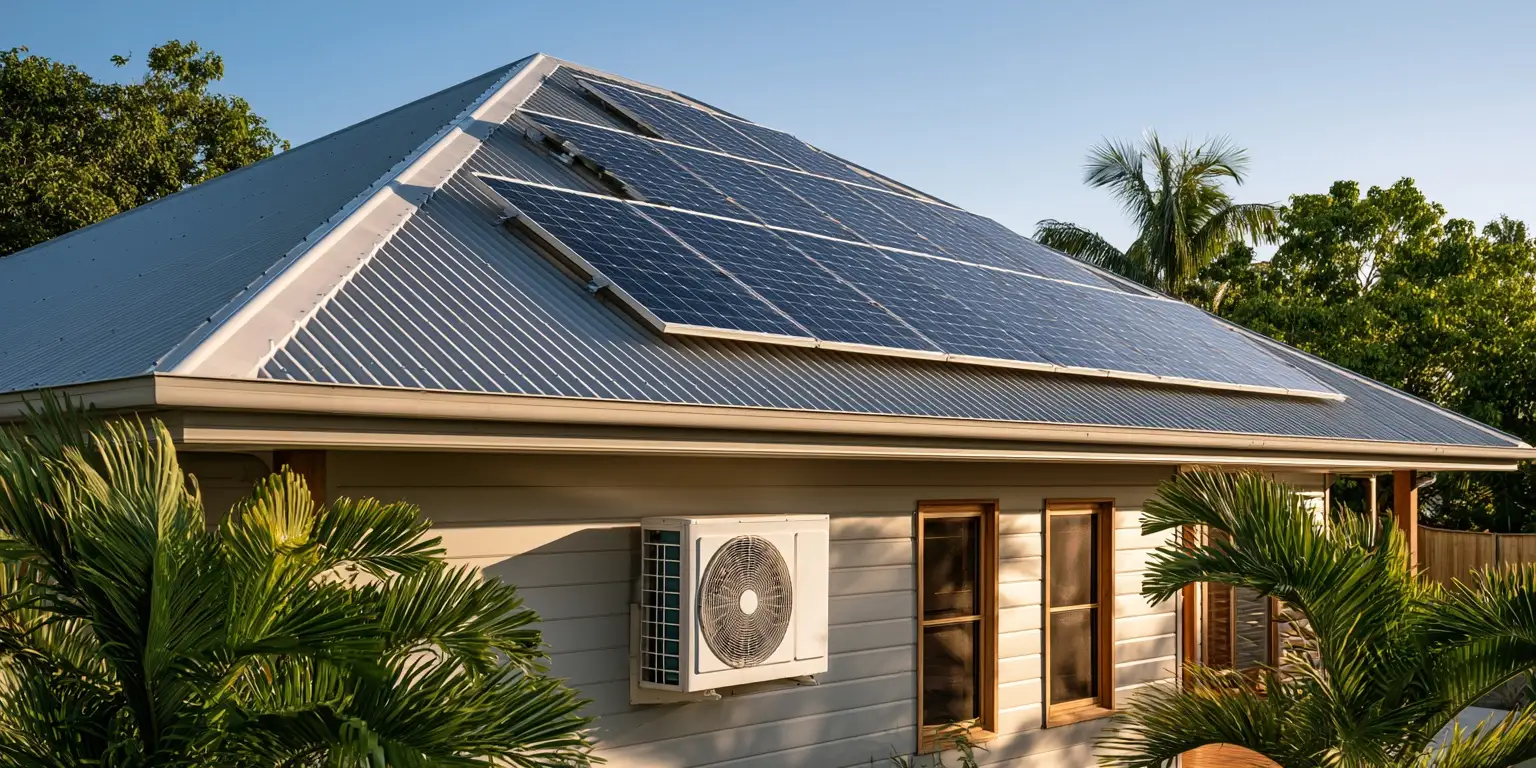
The pitch is familiar. You have solar on the roof, so the air conditioning is effectively free. It is a nice idea and it does not survive contact with how people actually use a house.
Rooftop solar produces most of its energy between mid morning and mid afternoon, and generation falls away sharply in the last couple of hours before sunset. Air conditioning in a Cairns home does the opposite. Demand peaks in the evening, when the building fabric is releasing the heat it absorbed all day, when the family is home, and when everyone wants a bedroom cool enough to sleep in. The system then runs through a good part of the night, generating nothing.
Without a battery, an air conditioner used mainly in the evening is billed at full retail rates like any other load. Solar helps the daytime portion, which in a working household is often the smallest part of it.
Where solar genuinely does help
There are real gains available, they are just more specific than the pitch suggests.
If someone is home during the day, a working from home office or a retired household, daytime cooling is close to the ideal solar load and the saving is real.
Pre cooling is the underrated one. Feed in tariffs are now well below what you pay to buy electricity back, so a kilowatt hour you use yourself is worth considerably more than one you export. Running the system harder in the late afternoon while the sun is still up, and letting the house coast on its own thermal mass into the evening, converts export into self consumption. It works better in a well insulated slab on ground home than in an uninsulated high set timber house, and it works better on a ducted system that can bring the whole envelope down rather than a single room.
A battery changes the picture entirely, and that is a solar conversation rather than an air conditioning one. The same arithmetic drives commercial air conditioning harder still, because a business is drawing its load during exactly the hours the panels are producing.
| How you use the house | How much your solar actually helps |
|---|---|
| Someone home through the day | A lot, daytime cooling is close to an ideal solar load |
| Empty all day, cooling from 6pm | Very little without a battery |
| Bedrooms only, overnight | Almost none without a battery |
| Pre cooling late afternoon, coasting into the evening | Meaningful, and it costs nothing to try |
| Well insulated slab on ground home | Pre cooling holds, so the gain is real |
| Uninsulated high set timber home | Pre cooling leaks away within the hour |
| Battery installed | Changes the picture entirely |
Inverter behaviour and what the star rating is telling you
An inverter compressor varies its speed and settles into a low steady output once the space is at temperature. A fixed speed unit only has full on and off, so it cycles hard all night. In this climate the difference is significant, both on the bill and on comfort, because the inverter is dehumidifying continuously rather than in bursts.
The label is the other piece, and most people read the wrong number off it. The zoned energy rating label gives separate star ratings and annual energy figures for hot, average and cold climate zones. Cairns is the hot zone. That is the figure that applies to you, and it is not always the one printed largest or the one quoted in the advertisement. Two units with the same headline stars can differ meaningfully once you read the hot zone column.
The things that move the bill most
In rough order of how much difference they make:
- Correct sizing. A short cycling oversized unit is inefficient and uncomfortable at the same time, and no setting fixes it afterwards
- A clean coil and clean filters. Restricted airflow raises consumption directly, and it is the cheapest thing on this list
- Sensible set points. Each degree lower costs real energy, and in this climate 24 with the humidity pulled down beats 21 with it left in
- Closing rooms off. Conditioned air escaping into a roof space or up a stairwell is capacity you paid for and did not use
- Inverter rather than fixed speed, if the system is still being chosen
- Reading the hot zone column on the energy label rather than the headline stars
If a whole of house system is on the table, read what ducted air conditioning in Cairns involves, and we will talk honestly about whether your solar suits it. Call 0489 266 523 to go through your usage pattern.
-
What Size Air Conditioner Do I Need
Why oversizing is the most common and most expensive sizing mistake in the tropics.
-
Cyclone Rated Air Conditioner Installation
A bracket is only ever as strong as whatever it is bolted into.
-
Salt Air and Air Conditioners
A corroded coil stops transferring heat long before the unit stops running.
Ask for a price
You get a straight answer about what the job needs, including when it does not need us.
- Hours
- Weekdays 7 until 5, Saturday mornings
- Area
- Cairns, the beaches, and south to the Cassowary Coast
- Quotes
- In writing, itemised, no obligation
- We ask what the rooms are doing before we quote a size, not after.
- The quote covers the mount, the line set, the electrical and the make good, so there are no line items appearing on install day.
- Written, itemised, and yours to compare against anyone else's.